
Table of Contents
- Why OTA Chambers Are Critical for 5G and IoT Testing
- How to Calculate OTA Chamber Size for Antenna Testing
- Quiet Zone Requirements in OTA Chambers
- OTA Chamber Design for 5G Specific Challenges
Over-the-air (OTA) testing has become essential for modern wireless products such as 5G smartphones, IoT sensors, wearables, and connected devices. As wireless technology advances and antenna systems become more complex, engineers must validate real-world wireless performance in controlled environments.
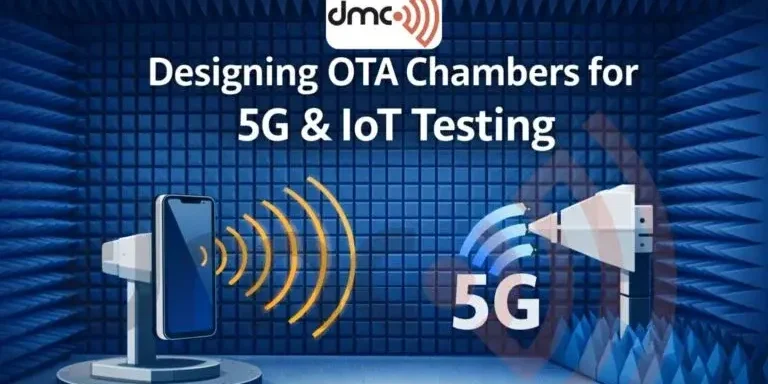
An OTA chamber is a specialized RF test environment designed to measure wireless performance, antenna radiation patterns, throughput, and signal quality without interference from external signals.
Designing an OTA chamber requires careful consideration of RF isolation, chamber dimensions, antenna positioning, and quiet zone requirements. If the chamber is poorly designed, test results can be inaccurate, leading to certification failures or degraded device performance.
This guide explains how to design an OTA chamber for 5G and IoT devices, how to determine the correct chamber size, and how to maintain proper quiet zone conditions for accurate testing.
Why OTA Chambers Are Critical for 5G and IoT Testing
Traditional conducted testing measures RF performance using cables connected directly to the device. However, modern devices integrate multiple antennas, beamforming systems, and compact form factors, making conducted measurements insufficient.
OTA chambers enable engineers to evaluate:
- Antenna radiation patterns
- Total Radiated Power (TRP)
- Total Isotropic Sensitivity (TIS)
- Beamforming performance
- Wireless throughput
- Multi-antenna (MIMO) behavior
For 5G and IoT, OTA testing is particularly important because:
- Devices often use multiple frequency bands
- Antennas are embedded in compact designs
- Performance depends on real-world signal propagation
- Certification bodies require OTA validation

How to Calculate OTA Chamber Size for Antenna Testing
One of the most important steps in OTA chamber design is determining the correct chamber dimensions. The chamber must be large enough to simulate far-field antenna conditions while minimizing reflections.
Key Factors Affecting Chamber Size
Several factors influence the required OTA chamber size:
- Device operating frequency
- Antenna size
- Test distance
- Quiet zone size
- Measurement methodology
Far-Field Distance Calculation
To accurately measure antenna radiation patterns, the device under test (DUT) must be placed at an appropriate far-field distance from the measurement antenna.
The far-field distance is typically calculated using:
R=(2D^2)/λ
Where:
- R = far-field distance
- D = largest antenna dimension
- λ = wavelength
Higher frequencies (like 5G mmWave) generally require shorter far-field distances, while lower frequencies need larger test distances.
Typical OTA Chamber Sizes
Below is a general guideline for chamber sizes used in wireless testing.
| Application | Frequency Range | Typical Chamber Size | Quiet Zone Diameter |
|---|---|---|---|
| IoT Devices | 700 MHz – 6 GHz | 3–5 m | 0.5–1 m |
| Smartphones | 700 MHz – 6 GHz | 5–8 m | 1–1.5 m |
| 5G mmWave | 24–40 GHz | 2–4 m | 0.3–0.8 m |
| Automotive Radar | 76–81 GHz | 4–10 m | 1–2 m |
| Massive MIMO Testing | Sub-6 GHz | 8–12 m | 2–3 m |
Chamber Layout Components
A typical OTA chamber includes:
- RF absorbing walls
- Measurement antenna
- Device positioner/turntable
- Quiet zone
- RF shielded enclosure
- Instrumentation outside the chamber
The device is placed on a rotating platform so engineers can measure radiation patterns across all angles.
Design Considerations
When determining chamber size, engineers must also consider:
1. Absorber thickness
RF absorbers reduce reflections and influence effective chamber size.
2. Measurement antenna placement
The antenna must remain outside the quiet zone.
3. Test automation equipment
Positioners, probes, and robotic arms require additional space.
4. Future scalability
Designing slightly larger chambers allows testing of future wireless standards.
Quiet Zone Requirements in OTA Chambers
The quiet zone is the most critical region inside an OTA chamber. It is the area where the electromagnetic field must be uniform and free from reflections so measurements accurately represent free-space conditions.
What Is a Quiet Zone?
The quiet zone is the test volume where the device under test (DUT) is placed. Within this region:
- RF reflections must be minimal
- Field uniformity must be maintained
- Signals must behave like they do in free space
If reflections occur within the quiet zone, measurements such as TRP and TIS can become unreliable.
Quiet Zone Design Criteria
To maintain accurate testing conditions, quiet zones must meet several RF performance criteria.
| Parameter | Typical Requirement |
|---|---|
| Amplitude Ripple | ±1 dB |
| Phase Variation | ±10° |
| Reflections | < -30 dB |
| Field Uniformity | ±1.5 dB |
| Cross Polarization | < -20 dB |
These specifications ensure that radiation measurements reflect the actual antenna behavior of the device.
How Quiet Zones Are Achieved
OTA chambers achieve quiet zone conditions using several design techniques.
RF Absorbers
Pyramidal absorbers made from carbon-loaded foam absorb RF signals and prevent reflections.
Chamber Geometry
Careful placement of antennas and absorbers reduces multipath reflections.
Shielding
Metal enclosures block external RF signals such as cellular networks, Wi-Fi, and broadcast transmissions.
Turntable Isolation
The DUT positioner must be designed to avoid reflections and interference.
Quiet Zone Validation
Before using the chamber for certification testing, engineers perform quiet zone verification.
Common validation techniques include:
- Field uniformity measurements
- Probe scanning
- Time-domain gating
- Reflection coefficient analysis
If performance does not meet standards, absorbers may need repositioning or additional shielding.
OTA Chamber Design for 5G Specific Challenges
5G introduces several new testing challenges compared to legacy wireless systems.
Beamforming Antennas
5G devices use beamforming arrays, which dynamically steer signals toward base stations. OTA chambers must support testing across multiple beam angles.
Massive MIMO
Massive MIMO systems require testing with multiple antennas simultaneously, increasing chamber complexity.
Millimeter Wave Frequencies
5G mmWave signals behave differently than sub-6 GHz frequencies.
Challenges include:
- Higher path loss
- Greater sensitivity to reflections
- Smaller antennas
- Shorter wavelengths
Because of this, mmWave OTA chambers often use compact antenna test ranges (CATR) with reflectors to simulate far-field conditions in smaller spaces.
Key Components of a Modern OTA Chamber
A well-designed OTA chamber includes several critical subsystems.
1. RF Shielded Enclosure
Prevents external interference from affecting measurements.
2. Absorber Lining
Suppresses reflections and creates anechoic conditions.
3. Positioning System
Rotates the device for full 3D radiation pattern measurement.
4. Measurement Antennas
Capture signals from the device across different frequencies.
5. Test Automation Software
Controls measurement equipment and processes results.
Pro Tip
Design your OTA chamber for future wireless standards, not just current ones.
Wireless technologies evolve rapidly, and upgrading an OTA chamber later can be expensive. Plan for higher frequencies, larger antennas, and advanced MIMO systems when determining chamber size and infrastructure.
Designing an OTA chamber for 5G and IoT device testing requires careful planning and engineering. Chamber size, far-field distance, absorber placement, and quiet zone performance all play crucial roles in achieving accurate wireless measurements.
A properly designed OTA chamber enables engineers to evaluate antenna performance, validate wireless connectivity, and meet regulatory certification requirements. As wireless technologies continue to evolve, well-designed test environments will remain essential for ensuring reliable device performance.
Frequently Asked Questions
1. What is an OTA chamber used for?
An OTA chamber is used to measure wireless device performance, including antenna radiation patterns, TRP, TIS, and signal quality in a controlled RF environment.
2. What is the quiet zone in an OTA chamber?
The quiet zone is the region inside the chamber where electromagnetic fields are uniform and free from reflections, allowing accurate antenna measurements.
3. How big should an OTA chamber be?
OTA chamber size depends on operating frequency, antenna dimensions, and required far-field distance. Chambers typically range from 3 m to 12 m.
4. Why are absorbers used in OTA chambers?
RF absorbers reduce reflections from chamber walls and simulate free-space conditions, ensuring accurate antenna testing.
5. Can OTA chambers test 5G mmWave devices?
Yes. Specialized OTA chambers with compact antenna test ranges are designed to test 5G mmWave devices operating above 24 GHz.