
Table of Contents
- What Are RF Honeycomb Vents?
- Why Ventilation Matters in RF Shielded Enclosures
- How RF Honeycomb Vents Block EMI
- Key Design Parameters of RF Honeycomb Vents
- Shielding Effectiveness vs Airflow: The Core Trade-Off
- Common Applications of RF Honeycomb Vents
- Installation Best Practices
- Testing and Standards
- Choosing the Right RF Honeycomb Vent
In environments where sensitive electronic equipment operates, controlling electromagnetic interference (EMI) is critical. From RF shielded rooms and anechoic chambers to data centres, defence facilities, and medical imaging suites, maintaining electromagnetic compatibility (EMC) is non-negotiable. However, these spaces also require proper ventilation to manage heat and ensure system reliability. This is where RF honeycomb vents play a vital role—providing airflow without compromising EMI shielding effectiveness.
This article explores the fundamentals of RF honeycomb vents, how they work, and how engineers balance airflow performance with shielding effectiveness.
What Are RF Honeycomb Vents?
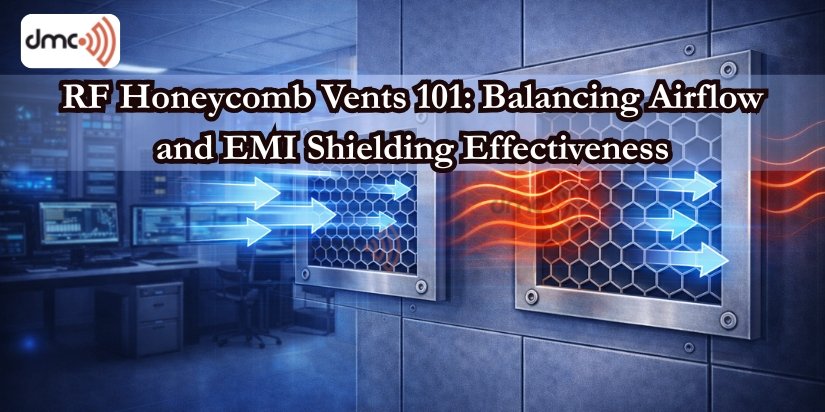
RF honeycomb vents are EMI-shielded ventilation panels designed to allow air passage while blocking electromagnetic waves. They consist of a matrix of conductive hexagonal or rectangular cells—similar to a honeycomb—typically made from aluminum, steel, or plated materials.
The unique geometry of these vents allows airflow to pass freely while attenuating RF and microwave frequencies, making them ideal for shielded enclosures where both thermal management and EMI protection are required.
Why Ventilation Matters in RF Shielded Enclosures
RF shielded rooms and enclosures are often sealed with conductive materials to prevent electromagnetic leakage. While this provides excellent shielding, it also traps heat generated by:
- RF transmitters and receivers
- Test equipment and amplifiers
- Servers and power supplies
- Medical or defense electronics
Without adequate ventilation, heat buildup can lead to equipment failure, inaccurate test results, or reduced lifespan. Traditional ventilation methods, however, can create EMI leakage paths. RF honeycomb vents solve this challenge by enabling controlled airflow while maintaining shielding integrity.
How RF Honeycomb Vents Block EMI
The EMI shielding principle behind honeycomb vents is based on waveguide below cutoff theory. Each cell in the honeycomb structure acts as a miniature waveguide. When the dimensions of the cell are smaller than the wavelength of the incident electromagnetic signal, the signal is attenuated rather than transmitted. In simple terms:
- Low-frequency, long-wavelength signals are blocked
- High-frequency signals experience significant attenuation
- Airflow, which is not affected by electromagnetic constraints, passes through
freely
The depth, cell size, and material conductivity determine how effectively the vent blocks EMI.

Key Design Parameters of RF Honeycomb Vents
Balancing airflow and shielding effectiveness requires careful consideration of several design factors.
1. Cell Size
Smaller cell sizes improve shielding performance, especially at higher frequencies. However, smaller cells restrict airflow and increase pressure drop.
- Small cells → Higher EMI shielding, lower airflow
- Large cells → Better airflow, reduced shielding effectiveness
Selecting the right cell size depends on the frequency range that needs to be attenuated.
2. Vent Depth (Thickness)
The depth of the honeycomb structure directly impacts EMI attenuation. Deeper vents provide better shielding but can reduce airflow efficiency and increase cost.
- Shallow vents → Moderate shielding, better airflow
- Deep vents → High shielding effectiveness, increased airflow resistance
3. Material and Surface Finish
RF honeycomb vents are typically made from:
- Aluminum (lightweight, corrosion-resistant)
- Steel (higher mechanical strength)
- Copper-plated or nickel-plated materials (enhanced conductivity)
Higher conductivity materials provide better EMI shielding but may increase weight and cost.
4. Open Area Ratio
The open area ratio refers to the percentage of open space available for airflow.
- High open area → Improved ventilation
- Low open area → Increased shielding effectiveness
Designers must strike a balance between thermal performance and EMI requirements.
Shielding Effectiveness vs Airflow: The Core Trade-Off
One of the biggest challenges in RF enclosure design is achieving both high shielding effectiveness(SE) and adequate airflow.
Typical performance expectations:
- Shielding effectiveness: 60 dB to 120 dB (depending on frequency)
- Airflow efficiency: Optimized to minimize pressure drop
Increasing shielding effectiveness almost always reduces airflow. Therefore, engineers must evaluate:
- Heat load inside the enclosure
- Required air changes per hour
- Target EMI attenuation levels
In many applications, slightly compromising airflow in favor of EMI protection is acceptable, provided forced cooling systems compensate for reduced ventilation.
Common Applications of RF Honeycomb Vents
RF honeycomb vents are widely used across industries where EMI control is essential:
- Anechoic chambers for antenna and RF testing
- EMI/EMC test labs
- Data centres and server rooms
- Defense and aerospace facilities
- Medical imaging rooms (MRI, CT scan)
- Telecommunication shelters
- Shielded racks and cabinets
In each case, the vent design is personalized to meet specific airflow and shielding requirements.
Installation Best Practices
Even the best-designed RF honeycomb vent can fail if installed incorrectly. Key installation considerations include:
- Ensuring continuous electrical bonding to the enclosure
- Avoiding gaps or non-conductive mounting hardware
- Using EMI gaskets where required
- Aligning airflow direction with cooling system design
Proper installation ensures that the vent does not become a weak point in the EMI shielding system.
Testing and Standards
RF honeycomb vents are often tested according to international standards such as:
- IEEE 299
- MIL-STD-285
- IEC 61000 series
These tests measure shielding effectiveness across different frequency ranges, helping engineers validate performance before deployment.
Choosing the Right RF Honeycomb Vent
When selecting an RF honeycomb vent, consider:
- Required shielding effectiveness (in dB)
- Frequency range of concern
- Airflow and cooling requirements
- Environmental conditions (humidity, corrosion, vibration)
- Compliance with applicable standards
Custom-designed vents are often preferred for mission-critical applications to achieve the best balance between performance and reliability.
RF honeycomb vents are a crucial component in modern EMI-shielded environments, offering an elegant solution to the challenge of ventilation without compromising electromagnetic protection. By carefully balancing cell size, depth, material, and open area ratio, engineers can achieve optimal airflow while maintaining high shielding effectiveness.
As electronic systems become more sensitive and regulations more stringent, the role of RF honeycomb vents will continue to grow—making them an essential element in the design of high-performance, EMI-controlled
facilities.
Frequently Asked Questions
1. What are RF honeycomb vents used for?
RF honeycomb vents are used to allow airflow for cooling while maintaining high EMI/RFI shielding
effectiveness in electronic enclosures, anechoic chambers, data centers, and defense systems.
2. How do RF honeycomb vents provide EMI shielding?
They use a conductive honeycomb cell structure that blocks electromagnetic interference while permitting
air to pass through, ensuring minimal signal leakage.
3. What materials are commonly used in RF honeycomb vents?
Common materials include aluminum, steel, stainless steel, and plated alloys, often finished with
chromate or conductive coatings for enhanced EMI performance.
4. How do honeycomb vents balance airflow and shielding effectiveness?
The balance depends on cell size, depth, and material conductivity. Smaller cell sizes improve
shielding,while optimized depth ensures sufficient airflow without compromising EMI protection.
5. Where are RF honeycomb vents typically installed?
They are widely used in EMC/EMI test chambers, RF shielded rooms, military communication systems, medical
equipment, and high-performance electronic enclosures.