
Table of Contents
- What is Pre-Compliance OTA Testing?
- What is Compliance OTA Testing?
- Core Differences at a Glance
- Cost Tradeoffs: Short-Term Savings vs Long-Term Losses
- Risk Tradeoffs: Where Most Companies Fail
- Real-World Cost vs Risk Scenario
- When Should You Invest in Pre-Compliance OTA Testing?
- Strategic Testing Roadmap
- Hidden Costs of Skipping Pre-Compliance
- ROI Perspective: Is Pre-Compliance Worth It?
Over-the-Air (OTA) testing has become a critical requirement for modern wireless products — from smartphones and IoT devices to automotive telematics and 5G modules. As regulatory requirements tighten and product complexity increases, manufacturers must carefully balance cost, risk, and time-to-market when planning their OTA testing strategy.
One of the most important strategic decisions involves understanding the difference between pre-compliance OTA testing and compliance OTA testing.
Many companies underestimate this distinction — and it often leads to costly redesigns, certification delays, and unexpected financial setbacks.
In this guide, we’ll break down:
- What pre-compliance OTA testing is
- What compliance OTA testing involves
- Cost differences
- Risk tradeoffs
- When to invest in each
- Best practices to reduce certification failures
What is Pre-Compliance OTA Testing?
Pre-compliance OTA testing is an internal or early-stage evaluation performed before submitting a device to an accredited certification laboratory.
It is not legally required — but it is strategically valuable.
Pre-compliance testing helps engineering teams:
- Identify antenna inefficiencies
- Detect radiation pattern distortions
- Evaluate TRP (Total Radiated Power) and TIS (Total Isotropic Sensitivity)
- Detect EMC and coexistence issues
- Validate early 5G beamforming performance
This testing is typically performed:
- In internal anechoic chambers
- At R&D labs
- At third-party engineering test facilities
The goal is simple:
Find problems early — when fixing them is still affordable.
What is Compliance OTA Testing?
Compliance OTA testing is the official certification process required for regulatory approval and market entry.
It must be performed in an accredited lab that meets standards defined by:
- FCC (USA)
- CE (Europe)
- PTCRB
- GCF
- Carrier certification bodies
Compliance testing validates that the product meets mandatory standards for:
- RF exposure limits
- TRP/TIS thresholds
- Spurious emissions
- Band-specific requirements
- 5G NR OTA performance
Without passing compliance testing, a product cannot legally be sold in regulated markets.
Core Differences at a Glance
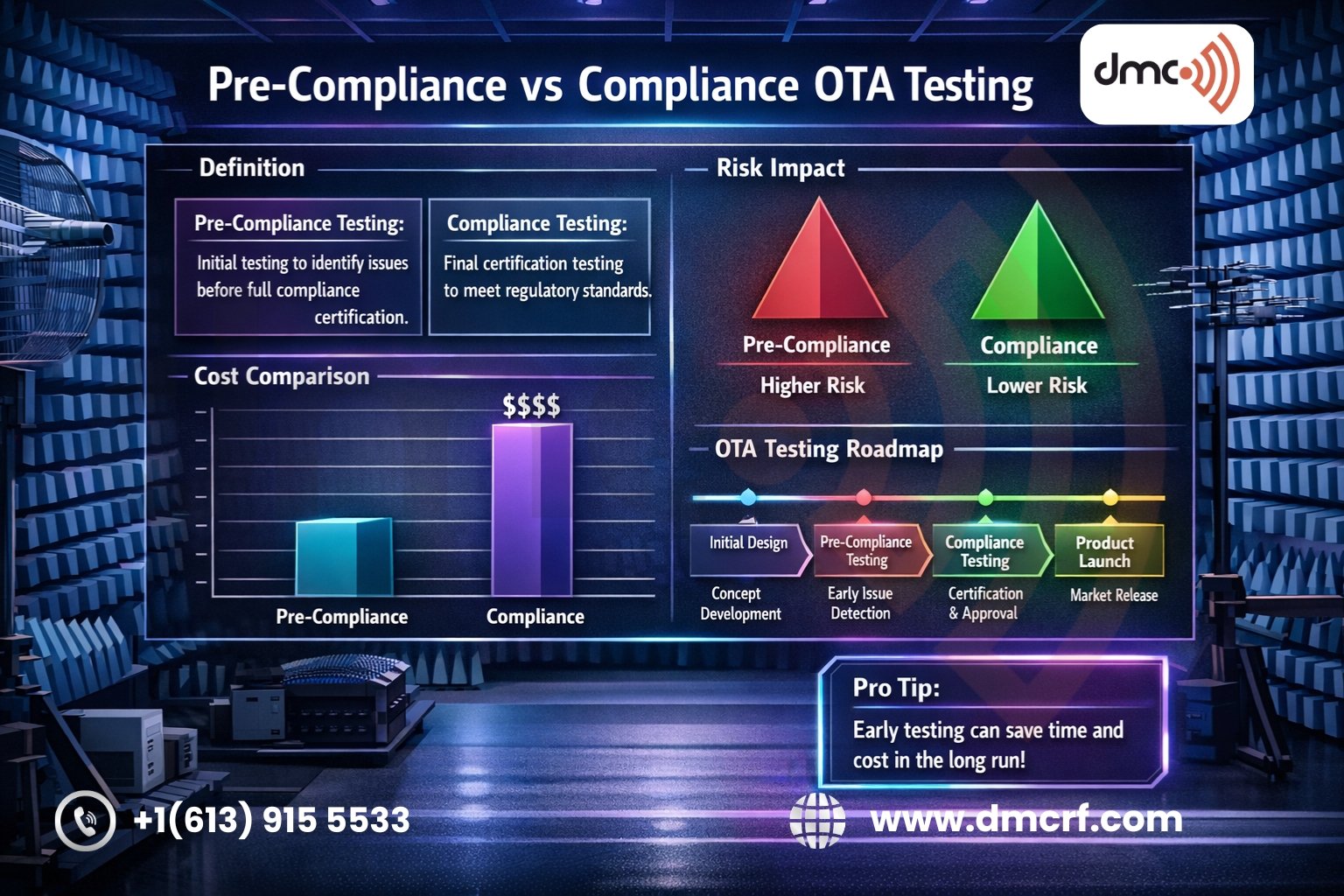
| Parameter | Pre-Compliance OTA Testing | Compliance OTA Testing |
|---|---|---|
| Purpose | Risk reduction | Legal certification |
| Timing | Early development stage | Final validation stage |
| Mandatory? | No | Yes |
| Cost | Lower | Higher |
| Flexibility | High (iterative testing allowed) | Limited (strict procedures) |
| Risk of Redesign | Low if issues found early | High if failure occurs |
| Documentation | Internal reports | Regulatory-approved reports |
| Lab Requirement | In-house or engineering lab | Accredited certification lab |
Cost Tradeoffs: Short-Term Savings vs Long-Term Losses
1. Pre-Compliance Costs
Pre-compliance testing generally costs:
- 30–60% less than full compliance testing
- Flexible scheduling
- Iterative testing sessions allowed
Typical expenses include:
- Chamber time
- Engineering analysis
- Antenna tuning
- Prototype modification
However, these costs are predictable and manageable.
2. Compliance Testing Costs
Compliance testing involves:
- Accredited lab fees
- Full documentation packages
- Regulatory filing fees
- Retest fees (if failure occurs)
If a device fails compliance testing, costs escalate quickly:
- Retesting fees
- Redesign expenses
- PCB modifications
- New antenna tooling
- Project delays
- Market opportunity loss
A single compliance failure can cost 3x–5x more than early pre-compliance testing.
Risk Tradeoffs: Where Most Companies Fail
The biggest mistake companies make is skipping or minimizing pre-compliance testing.
Here’s why that’s dangerous:
Risk 1: Antenna Detuning
Small PCB layout changes can shift antenna performance significantly. Without pre-validation, TRP/TIS values may fall below regulatory thresholds.
Risk 2: Late-Stage Redesign
At compliance stage, the product is usually:
- Tooling finalized
- Industrial design locked
- Firmware frozen
- Mass production scheduled
Making RF changes at this stage is extremely expensive.
Risk 3: Certification Delays
Missing a certification window can:
- • Delay product launch by 2–3 months
- • Miss seasonal sales cycles
- • Impact investor confidence
- • Damage brand credibility
Real-World Cost vs Risk Scenario
Imagine a 5G IoT device ready for FCC testing.
Scenario A – With Pre-Compliance Testing:
- Antenna mismatch detected early
- PCB adjusted in prototype phase
- Minor cost increase
- Compliance passed on first attempt
Scenario B – Without Pre-Compliance Testing:
- Device fails TRP threshold
- PCB redesign required
- New tooling
- 6-week delay
- Additional $40,000–$80,000 expense
The decision becomes clear.
When Should You Invest in Pre-Compliance OTA Testing?
Pre-compliance is especially critical when:
- Launching a new antenna design
- Integrating multiple radios (Wi-Fi + 5G + Bluetooth)
- Designing compact IoT products
- Implementing Massive MIMO
- Using metal enclosures
- Entering new regulatory markets
If your RF design complexity is high, pre-compliance testing is not optional — it’s strategic insurance.
Strategic Testing Roadmap
A smart OTA testing strategy typically follows this sequence:
- Antenna simulation (EM modeling)
- Early prototype OTA testing
- Iterative antenna tuning
- Pre-compliance validation
- Final design freeze
- Compliance OTA testing
- Regulatory submission
This layered approach reduces failure probability dramatically.
ROI Perspective: Is Pre-Compliance Worth It?
Yes — especially for:
- 5G devices
- Automotive modules
- Consumer electronics
- Smart home devices
- Medical wireless equipment
Spending 10–15% more upfront can prevent 200–300% loss later.
In regulated industries, risk mitigation always beats reactive correction.
Pro Tip:
Never schedule compliance OTA testing without at least one full-cycle pre-compliance validation using production-equivalent hardware.
Testing only engineering samples may hide real-world performance issues caused by final enclosures, shielding, or manufacturing tolerances.
Treat pre-compliance as a rehearsal — compliance is the final exam.
Frequently Asked Questions
1. Is pre-compliance OTA testing mandatory?
No, but it significantly reduces the risk of failing official compliance testing.
2. Can I skip pre-compliance to save money?
Technically yes — but the financial risk of compliance failure is much higher.
3. How much does compliance OTA testing cost?
Costs vary by device type and region but can range from $15,000 to $50,000+.
4. What happens if a device fails compliance testing?
You must redesign, retest, and resubmit — causing delays and additional expenses.
5. Is pre-compliance testing required for 5G devices?
Not legally required, but strongly recommended due to higher RF complexity.