
Table of Contents
- Why GNSS OTA Testing Matters
- Designing a Chamber for GNSS Antenna Testing
- Key Design Considerations
- Typical GNSS OTA Chamber Components
- Challenges in GNSS Chamber Design
- Design Considerations for a Multi-Purpose OTA Chamber
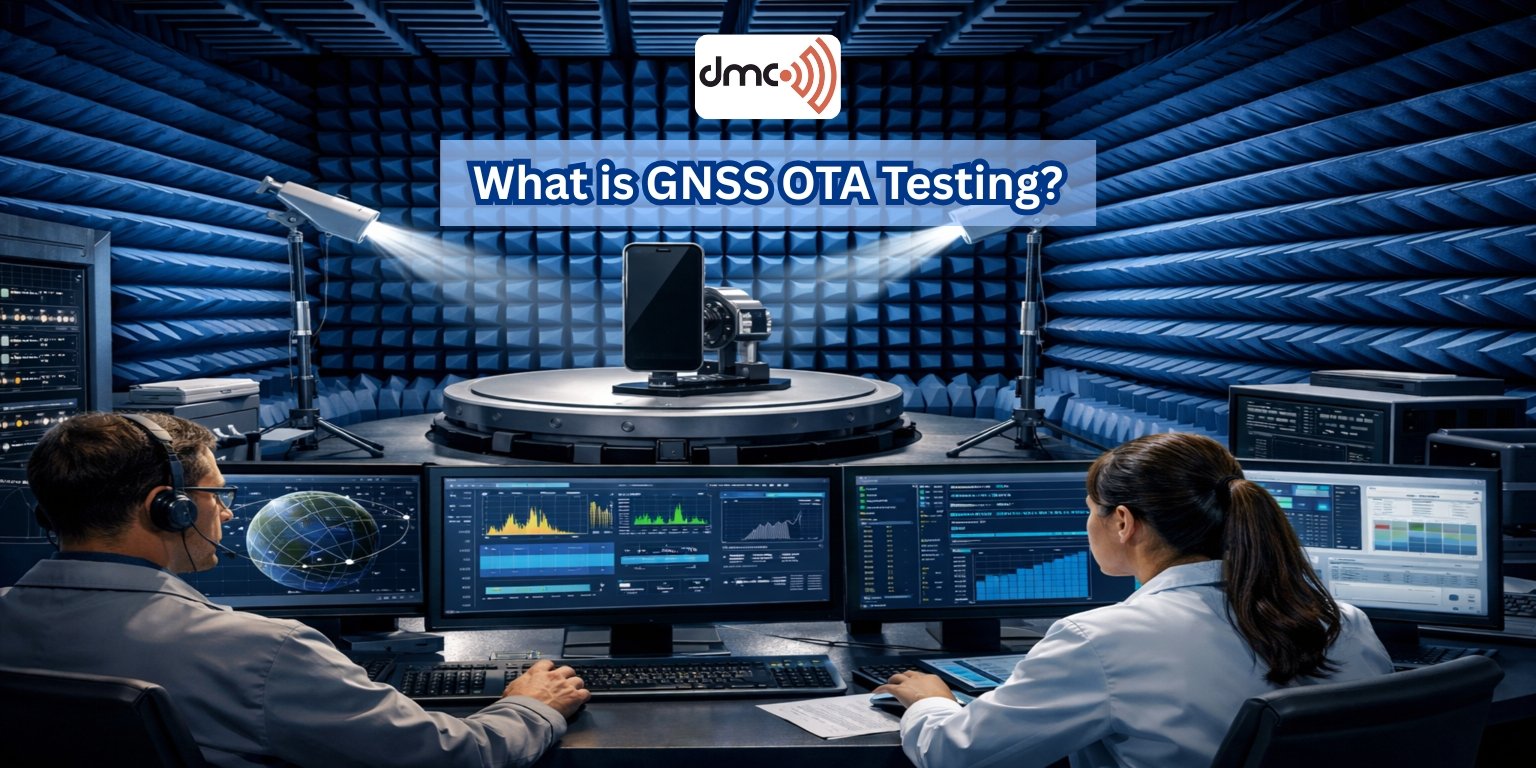
GNSS OTA (Over-the-Air)testing is a critical process used to evaluate the performance of Global Navigation
Satellite System (GNSS) receivers and antennas in real-world-like conditions without relying on direct cable
connections. Instead of injecting signals through connectors, OTA testing radiates signals wirelessly,
mimicking how devices receive satellite signals in actual environments.
GNSS includes systems like GPS, GLONASS, Galileo, and BeiDou. Devices such as smartphones, automotive
navigation systems, wearables, and IoT modules depend heavily on GNSS performance. OTA testing ensures that
these devices can accurately receive and process satellite signals under various conditions.
Unlike conducted testing, OTA testing captures the true behavior of antennas, including factors such as
radiation patterns, sensitivity, interference, and multipath effects. This makes it indispensable for
validating modern wireless devices where antenna performance is tightly integrated into the device design.
Why GNSS OTA Testing Matters
- Real-world simulation: Replicates satellite signal reception conditions
- Device-level validation: Tests full system performance, not just components
- Regulatory compliance: Meets industry and certification requirements
- Performance benchmarking: Ensures accurate positioning and reliability
As GNSS-enabled devices become more compact and multifunctional, OTA testing becomes the only reliable
way to assess their true navigation performance.
Designing a Chamber for GNSS Antenna Testing
Designing an OTA chamber for GNSS testing requires careful consideration of RF environment control,
signal integrity, and measurement accuracy. The goal is to create a controlled space that mimics
open-sky conditions while eliminating external interference.

Key Design Considerations
1. Anechoic Environment
The chamber must suppress reflections using RF absorbers. This ensures that only the intended signals
reach the device under test (DUT), avoiding multipath distortion.
2. Frequency Range Coverage
GNSS systems operate across multiple frequency bands:
- L1 (≈1575 MHz)
- L2 (≈1227 MHz)
- L5 (≈1176 MHz)
The chamber must support all relevant frequencies with minimal loss and distortion.
3. Quiet Zone
A defined region inside the chamber where the electromagnetic field is uniform and predictable. The DUT
is placed here to ensure accurate measurements.
4. Positioning System
A positioner or turntable is used to rotate the DUT, allowing measurement of radiation patterns and
sensitivity from different angles.
5. Signal Generation
GNSS simulators generate satellite signals that are transmitted via antennas inside the chamber. These
signals emulate real satellite constellations and movement.
6. Shielding Effectiveness
Proper shielding prevents external RF interference from entering the chamber and ensures measurement
accuracy.
Typical GNSS OTA Chamber Components
| Component | Purpose | Importance Level |
|---|---|---|
| RF Absorbers | Minimize reflections and multipath | High |
| GNSS Simulator | Generate satellite signals | Critical |
| Measurement Antenna | Transmit signals to DUT | High |
| Turntable/Positioner | Rotate DUT for pattern analysis | Medium |
| Shielded Enclosure | Block external interference | Critical |
| Control Software | Automate testing and data analysis | High |
Challenges in GNSS Chamber Design
- Weak signal levels: GNSS signals are extremely low power, making them sensitive to noise
- Multipath control: Even minor reflections can distort results
- Calibration complexity: Ensuring repeatable and accurate measurements
- Cost constraints: High-quality absorbers and simulators can be expensive
Pro Tip 💡
When designing a GNSS OTA chamber, prioritize quiet zone quality over chamber size. A smaller,
well-optimized chamber often delivers more accurate results than a larger but poorly controlled
environment.
Can One OTA Chamber Support Cellular and GNSS Testing?
A common question in RF testing is whether a single OTA chamber can handle both cellular (e.g., LTE, 5G)
and GNSS testing. The answer is: yes, but with careful design trade-offs.
Key Differences Between Cellular and GNSS Testing
| Parameter | GNSS Testing | Cellular Testing |
|---|---|---|
| Signal Strength | Very weak | Relatively strong |
| Frequency Range | Narrow (L-band) | Wide (sub-6 GHz to mmWave) |
| Test Objective | Position accuracy | Throughput, latency, connectivity |
| Sensitivity | Extremely high | Moderate |
| Interference Impact | Very high | Lower |
Design Considerations for a Multi-Purpose OTA Chamber
1. Wide Frequency Support
The chamber must accommodate both GNSS frequencies and cellular bands, including 5G.
2. Hybrid Absorber Design
Different absorbers may be required to handle both low-frequency GNSS signals and higher-frequency
cellular signals effectively.
3. Flexible Antenna Setup
Multiple antenna configurations may be needed to support different test scenarios.
4. Isolation and Filtering
Since GNSS signals are weak, strong cellular signals can interfere. Proper filtering and isolation are
essential.
5. Software Integration
Test systems must support both GNSS simulation and cellular network emulation.
Advantages of a Combined OTA Chamber
- Cost efficiency: Reduces infrastructure duplication
- Space saving: Ideal for labs with limited space
- Unified testing workflow: Streamlines device validation
Limitations
- Compromise in optimization: A chamber optimized for one may not be perfect for the other
- Complex setup: Requires careful calibration and configuration
- Higher initial design effort: More complex than dedicated chambers
When Should You Use Separate Chambers?
- When ultra-high precision GNSS testing is required
- When testing advanced 5G mmWave systems
- When regulatory certification demands specialized setups
GNSS OTA testing plays a vital role in ensuring the reliability and accuracy of modern
navigation-enabled devices. By simulating real-world satellite conditions, it provides insights that
conducted testing simply cannot achieve.
Designing a GNSS OTA chamber requires careful attention to RF isolation, absorber performance, and
signal integrity. While it is possible to combine GNSS and cellular testing in a single chamber, doing
so requires thoughtful engineering to balance performance and flexibility.
As wireless technologies continue to converge, multi-purpose OTA chambers are becoming increasingly
relevant. However, the choice between a unified or dedicated setup ultimately depends on your testing
requirements, budget, and desired accuracy.
Frequently Asked Questions
1. What is GNSS OTA testing used for?
It is used to evaluate the real-world performance of GNSS-enabled devices by testing their ability to receive satellite signals wirelessly.
2. Why is OTA testing better than conducted testing for GNSS?
OTA testing captures antenna behavior and environmental effects, providing a more accurate representation of real-world performance.
3. What is a quiet zone in an OTA chamber?
It is the area inside the chamber where the electromagnetic field is uniform, ensuring reliable measurements..
4. Can GNSS and cellular testing be done in the same chamber?
Yes, but it requires careful design to handle differences in signal strength, frequency, and sensitivity.
5. What are the key components of a GNSS OTA chamber?
RF absorbers, GNSS simulator, measurement antennas, shielded enclosure, and positioning systems.